Αναρτήσεις

Is the Universe a Quantum Computer?

 The idea that the Universe (whatever we may mean by this) is a some sort of a computer is a recurring theme. Recently, Nature published an article by David L. Chandler that is entitled Could the Universe be a giant quantum computer? This article is actually a tribute to Edward Fredkin, who passed away last June. The main contribution of Fredkin to the philosophy of science is his "digital philosophy" that advocates the idea that the universe is a computer and everything in our universe is discrete. I would not like to argue against the validity of these ideas (I have done so in Hypercomputation: Computing Beyond the Church-Turing Barrier and in Demystifying Computation: A Hands-On Introduction ) . However, I would like to point out that if the Universe is not a computing device, in general, then it cannot be a quantum computer, in particular. Also, what I did not like with Chandler's article is that it takes it for granted that the Universe is a computer. He did not e...
Gödel and Mathematics

Εικόνα
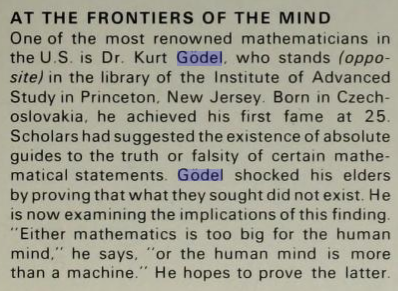
 On page 53 of the book Mathematics by David Bergamini one can read the following:  

On the Limits of Computation

 Recently I wrote an article on the The Limits of Computation , which was published in Philosophy Now . In this article I argue in favor of the idea that the limits of computation are currently unknown. In addition, I explore how this idea affects our understanding in a number of areas.

Using an electronic amoeba to quickly find an approximate solution to traveling salesman problem

The traveling salesman problem is about a salesman that has to start from a specific town and after visiting a number of towns only once, he/she has to return to the starting town. The real problem is to minimize the total length of the trip. It has been shown that this problem is NP-complete, which practically means that this is a very difficult problem to solve with a computer. However, Kenta Saito, Masashi Aono, and Seiya Kasai from Japan have shown that an electronic amoeba can give an approximate solution to this problem in linear time. Practically, this means that the new approach can transform a difficult problem to an easy one. The Japanese researchers reported their findings in a paper in scientific reports .

New milestone in quantum supremacy

A new kind of quantum computer that harnesses photons has achieved a new breakthrough in quantum supremacy. In particular, this machine completed a computational task in 200 seconds while an ordinary supercomputer would require 2.5 billion years. The computer employes a technique called Gaussian boson sampling (a photon is a boson) and a complete description of the machine is given in an article published in Sciece (everyone can read it for free).

New and Notable Books

Recently Lee Yiwata sent me a list of book related to hypercomputation. The list is rather complete but I would like to mention only the most recent titles that I did not happen to skim through. Biological Hypercomputation and Degrees of Freedom by Carlos Eduardo Maldonad. Interactive Computation: The New Paradigm edited by Dina Goldin, Scott A. Smolka, and Peter Wegner.  Ordinal Computability: An Introduction to Infinitary Machines by Merlin Carl. Computation and its Limits by Paul Cockshott, Lewis M Mackenzie, and Gregory Michaelson. Computational Matter edited by Susan Stepney, Steen Rasmussen, and Martyn Amos. Physical Computation: A Mechanistic Account by Gualtiero Piccinini. Church’s Thesis. Logic, Mind and Nature edited by Adam Olszewski, Bartosz Brożek, Piotr Urbańczyk. The books Computation and its Limits and Physical Computation: A Mechanistic Account are not in favor of hypercomputation, nevertheless, they might be of interest to some people. Personally, I am no...

Turing Machine Simulation

 Hypercomputation is about machines that transcend the computational power of the Turing machine. However, I think it is quite instructive to really understand the power of the Turing machine. Therefore, I think play with a Turing machine simulator is quite instructive. The Turing machine simulator by Martín Ugarte is a very interesting and powerful simulator that I recommend to everyone who wants to play with Turing machines.

The Rolf Nevanlinna Prize

A few days ago I read that Constantinos Daskalakis got the Rolf Nevanlinna Prize for  For transforming our understanding of the computational complexity of fundamental problems in markets, auctions, equilibria, and other economic structures. His work provides both efficient algorithms and limits on what can be performed efficiently in these domains. Thus, according to this, we now can somehow compute economies. However, even economists have started to realize that economies cannot be described with  mathematics only. In fact,  Why economists need to expand their knowledge to include the humanities is a recent article that discusses exactly this problem. Daskalakis's approach is based on the assumption that humans are Turing machines. Unfortunately, they are not and this is the reason why economists fail so miserably in their predictions. Furthermore, there are some other things that people who work in computational economics "fail" to realize. For example, ev...

Everything is computable...

Recently I read an article that presented a novel idea by  Nicolas Gisin . In a nutshell, Gisin says that  only a certain number of digits of real numbers have physical meaning. After some number of digits, for example, the thousandth digit, or maybe even the billionth digit, their values are essentially random. This is very interesting because it means that there are no noncomputable numbers. Provided this idea is correct, we can easily decide if for example there are three 4s in the decimal expansion of π! The real problem of course is to agree on the number of significant digits. Once this problem is settled, then we can answer any question about physical real numbers. Another consequence of this idea would be that real numbers might be directly representable in even present computer hardware. What is left is to examine deeply this idea and see if it is actually valid.

A "Solution" to Riemann Hypothesis

Riemann hypothesi s is "is a conjecture that the Riemann zeta function has its zeros only at the negative even integers and complex numbers with real part 1 2 ". The Riemann zeta function is conventionally represented as the sum: ζ ( z ) = ∑ k = 1 ∞ 1 k z Recently, I read in Peter Woit's blog that some researchers have published a paper that describes a  Hamiltonian operator H that can be used to possibly solve this problem. This operator has the property that if the eigenfunctions obey a suitable boundary condition, then the associated eigenvalues correspond to the nontrivial zeros of the Riemann zeta function! The paper is also available as a preprint . In a sense, this paper says that one can set up a quantum system whose evolution "solves" Riemann hypothesis. To me this is a reasonable approach to the solution of the problem. And it reminds me of the work of  Leonard Adlemam .

Multiverse and Computation

The idea that quantum computation is a manifestation of the multiverse is not new. For example, David Deutsch believes that quantum computers can be used to test its existence. Personally I believe that the multiverse is good for scripts of scifi series (e.g., the Fringer ) but that's all. But I think that something is also logically wrong with this idea. Roughly, the multiverse is the idea that there many copies of our universe (or some universe) and each evolves differently, yet in each one of them there is a copy of me but all these copies are different pairwise. Obviously, at each moment many things happen that can have different outcomes so in one universe a spermatozoon fuses with an ovum while in another this never happens but in another universe a different spermatozoon fuses with it. Practically, this means that in the first universe person A will be born, in the second nothing will happen while in the third person B will be born. If all these things are quite possible...

Memcomputing

Εικόνα
Memcomputing is a new computing paradigm that is based on the idea that the memory can and should be used to compute. The idea is based on the functionality of the brain where neurons are used to both store information and process it.  In particular the following drawing shows the way a memecomputer operates. The zigzag arrow specifies that  a signal is sent.  All other arrows designate flow of information. Now compare this architecture with the "traditional" von Neumann architecture: I think the difference is obvious. The interesting thing with me memcomputing is that the people who designed this computer architecture published a paper where they claim that memcomputers can solve NP-complete problems. In particular, they claim that their machine can solve instances of the subset sum problem. This problem can be phrased as follows:  Consider a finite set G of integers  having n elements, is there a non-empty subset K of G whose elements sum up to ...

Creator of EAC implementation passed away

Today I was informed that  Jonathan Wayne Mills , the creator of an implementation of the Extended Analog Machine passed away on January 27, 2016 at the age pf 64 after a six month fight against cancer. I am really saddened when I hear such tragic news. on Wednesday, January 27, 2016 at the age of 64, after a six month fight against cancer. - See more at: http://obits.mlive.com/obituaries/kalamazoo/obituary.aspx?page=lifestory&pid=177627505#sthash.st1ONYH7.dpuf on Wednesday, January 27, 2016 at the age of 64, after a six month fight against cancer. - See more at: http://obits.mlive.com/obituaries/kalamazoo/obituary.aspx?page=lifestory&pid=177627505#sthash.st1ONYH7.dpuf Jonathan Wayne Mills Jonathan Wayne Mills Jonathan Wayne Mills Jonathan Wayne Mills

A solution to Thomson’s Lamp?

Today I discovered a paper that claims to offer a solution to Thomson’s Lamp.The paper is entitled Hypercomputation, Frege, Deleuze: Solving Thomson's Lamp . Right now I have no time to read it and offer comments on it.

Deep Neural Networks are Easily Fooled!

In an article that was recently posted to the arXiv and is entitled Deep Neural Networks are Easily Fooled: High Confidence Predictions for Unrecognizable Images , the authors discuss how Deep neural networks (DNNs) can be fooled when performing visual classification. In particular, the show how  easy it is to produce images that are completely unrecognizable to humans yet that  DNNs believe they are recognizable objects with 99.99% confidence...!

Transfinite Computational Conceptual Devices

A nice review of transfinite conceptual computing devices by Philip Welch was posted to aRxin on September, 17. I think it would be interesting to readers to supplement the paper with a section on the (possible?) relation between these conceptual computing devices and physical reality.

Constructive Hypercomputation

Constructivists assert that one has to construct a mathematical object in order  to show that it exists. And for some reasons they reject hypercomputation. In particular, Rasoul Ramezanian notes correctly in A Hypercomputation in Brouwer's Constructivism that for Brouwer, who was the founder of the mathematical philosophy of intuitionism, something exists as long there is a mental construction for it and this is exactly the reason for the rejection. Some constructivists do not accept that there are infinite objects at all. In fact, some assert that there are 2 1000 elementary particles in the Universe and so they believe this is the largest number! To me such ideas are absurd. But Ramezanian concludes that intuitionism can co-exist with hypercomputation. Moreover, he presents his Persistent Evolutionary Turing Machines, which is a couple N = (⟨z 0 , z 1 ,…, z i ⟩, f ) where z 0 , z 1 ,…, z i is a growing sequence of codes of deterministic Turing machines, and f (called the ...

Implementing an Analog Recurrent Neural Network

Εικόνα
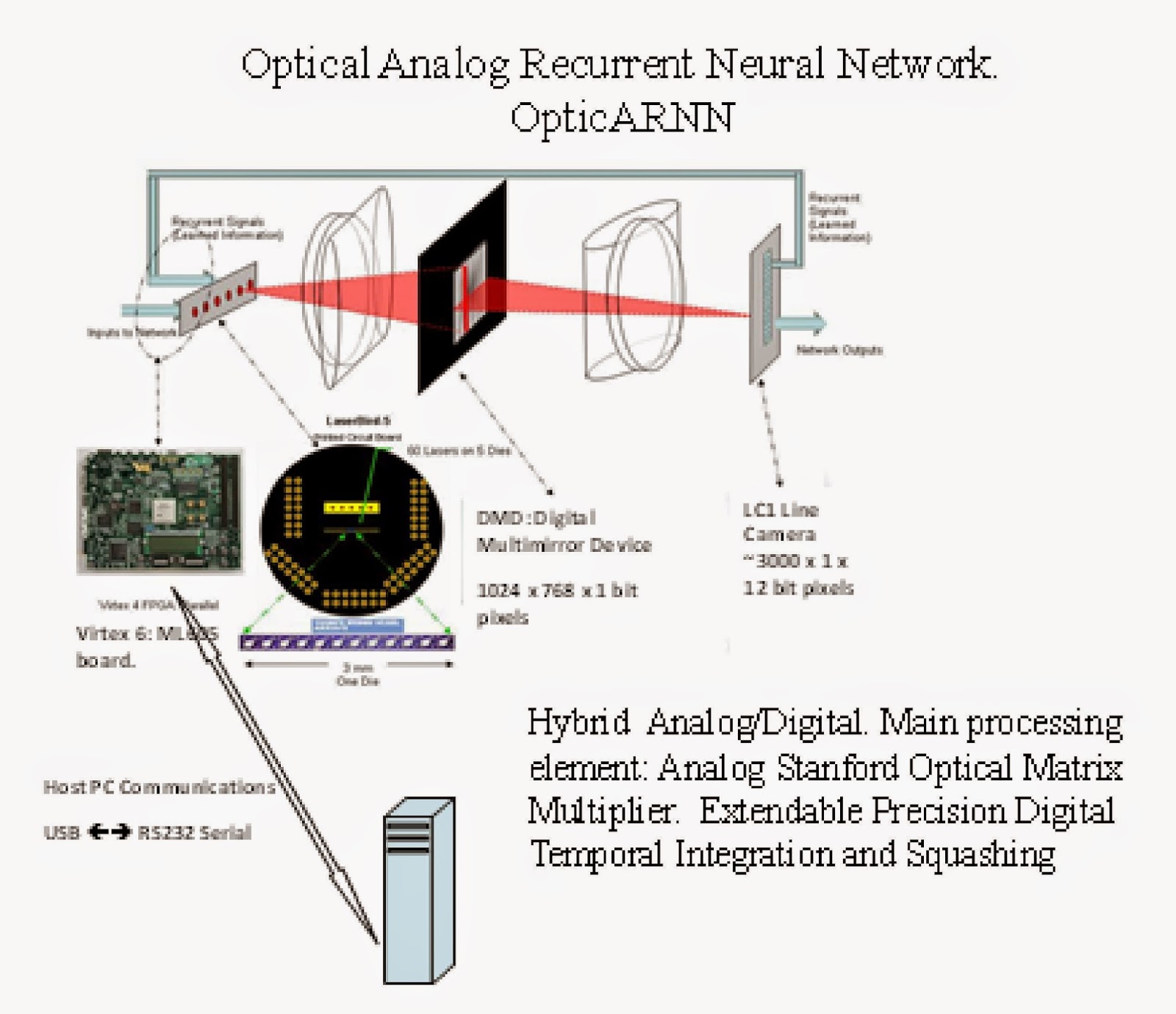
A. Steven Younger, Emmett Redd, and Hava Siegelmann published a paper entitled  Development of Physical Super-Turing Analog Hardware , where they report their efforts to build a real hypercomputer. In particular, they present their work on the realization of Analog Recurrent Neural Networks (ARNN, for short). The theory of ARNNs is presented in Neural Networks and Analog Computation .In a nutshel, the ARNNs are generally more powerful than Turing machines and so they are classified as hypecomputers. Younger  et al. have designed and developed an OpticARNN which is depicted in the figure that follows: Also, they have developed an electronic ARNN whose functional schematic follows: These system have not been tested thoroughly and so one cannot draw definitive conclusions. The authors plan to build larger devices and continue their studies.

Hypercomputation and the Axiom of Choice

In the preface of my book on hypercomputation I have stated that all models of computation described in the book assume the axiom of choice.  Instead of explaining  explicitly why it is needed. I give an excerpt from Gregory H. Moore's prologue to  Zermelo's Axiom of Choice in the hope that readers will understand why it is needed.  Yet  without the Axiom, mathematics today would be quite different. The very nature of modern mathematics would be altered and, if the Axiom's most severe constructivist critics prevailed, mathematics would be reduced to a collection of algorithms. Indeed, the Axiom epitomizes the fundamental changes—mathematical, philosophical, and psycological—that took place when mathematicians seriously began to study infinite collections of sets.

Is computation observer-relative?

The 7th AISB Symposium on Computing and Philosophy will examine whether computation is observer-related. In different words, participants will discuss whether computation is a sponteneous natural phenomenon or not. I think that computation, like art, is not a natural phenomenon. Nature is not a sculpturer or a painter, and for that matter not a programmer. To animals, a sculpture is just a stone or a piece of metal and that's all. Flowers are not beautiful or ugly: they just attract bees and other insects. Mountains are not fearsome and lakes are not picturesque. Only humans give this attributes to these physical entities. Similarly, no chair and no desk computes anything. In fact, even a computer does not compute anything unless someone would be able to interpret the result of the computation. I am sure that if one could present a computer to Aristotle he could not easily realize what kind of machine it is.